Delaying the replacement of deteriorated or outdated kitchen surfaces compromises structural integrity and drastically diminishes home value. In coastal microclimates like Del Mar, failing sealants and degraded seams allow marine moisture to penetrate sub-counter cabinetry, breeding hidden mold and causing base substrate warping that requires thousands of dollars in structural repairs. Upgrading via modern countertops services safeguards your investment while establishing contemporary architectural elegance designed to withstand coastal exposure.
The Critical Risks of Delaying Countertop Upgrades in Coastal Homes
Ignoring compromised kitchen countertops in Del Mar leads to rapid secondary damage throughout your cabinetry and flooring. Salt air and elevated ambient humidity exploit micro-fissures in aged granite, laminate, and failing tile grout. When moisture seeps past unsealed perimeter joints, it rots underlying plywood substrates, corrodes fasteners, and destabilizes heavy slab surfaces. In severe instances, structural deflection in warped cabinet boxes creates uneven load distribution, resulting in catastrophic slab cracking across unreinforced spans.
Property valuation in coastal San Diego County hinges heavily on interior finish quality. Real estate appraisals reflect significant penalties for worn, stained, or mechanically compromised kitchen surfaces. Postponing required renovations compounds total project expenses by adding mold remediation, drywall repair, and full cabinet replacement to the standard fabrication scope. Addressing surface degradation early eliminates structural contamination risks and secures peak market equity for your property before localized deterioration spreads.
Core Elements Defining 2026 Countertops Services in Del Mar
Modern coastal kitchen remodels balance aggressive environmental durability against refined minimalist aesthetics. Homeowners throughout Del Mar prioritize long-lasting mineral compositions that resist high ultraviolet exposure from floor-to-ceiling sliding glass doors while repelling airborne salinity. The National Kitchen and Bath Association (NKBA) 2025/2026 Design Trends Report confirms that over 78 percent of homeowners now select dense natural quartzites and large-format porcelain slabs over traditional porous marbles.
- Dense crystalline mineral compositions providing near-zero porosity and superior heat resistance.
- Seamless continuous vein matching executed through high-resolution digital slab mapping software.
- Integrated mitered sink basins and waterfall gable ends delivering clean architectural lines.
- Ultra-compact sintered surfaces designed specifically for outdoor and indoor-outdoor kitchen transitions.
- Matte, honed, and leathered tactile finishes that conceal coastal dust, glare, and daily fingerprint smudges.
These priorities demonstrate a decisive departure from high-gloss, heavily speckled granites toward organic, tactile stone profiles with dramatic veining. Discerning homeowners demand surfaces that perform reliably under heavy culinary use while anchoring open-concept living zones.
Next-Generation Stone Selections: Quartzite and Engineered Porcelain
Natural Quartzite Countertops dominate the luxury residential sector across Del Mar and neighboring Encinitas due to their exceptional hardness and aesthetic similarity to classic Calacatta marble. Unlike true calcite marbles, metamorphic quartzite rates at 7 on the Mohs hardness scale, making it impervious to etching from acidic citrus juices, balsamic vinegars, and wine spills common in gourmet prep zones. Slabs such as Taj Mahal, White Macaubas, and Mont Blanc offer warm neutral tones with dense structural stability that easily outlasts softer alternatives.
Concurrently, ultra-compact sintered porcelain surfaces represent the fastest-growing category for hybrid indoor-outdoor living spaces. Porcelain slabs withstand direct ultraviolet radiation without resin discoloration, handle direct contact with scorching cookware, and exhibit zero water absorption. While raw engineered quartz contains petroleum-based binding resins vulnerable to exterior thermal shock, modern porcelain utilizes pure clay minerals fired at temperatures exceeding 2,200 degrees Fahrenheit, ensuring lifetime colorfastness across sun-drenched patio kitchens.
Material Performance Metrics for Coastal Kitchen Environments
Selecting the ideal surface requires evaluating mechanical characteristics against coastal environmental factors. Salt fog, solar thermal gain, and daily culinary abrasion dictate specific material performance standards.
| Material Type | Mohs Hardness | Porosity Rating | UV Stability | Heat Resistance |
|---|---|---|---|---|
| Metamorphic Quartzite | 7.0 to 7.5 | Under 0.5% | Excellent | Up to 1,000°F |
| Ultra-Compact Porcelain | 8.0 | Zero (0.01%) | Impervious | Up to 1,200°F |
| Engineered Quartz | 6.5 to 7.0 | Non-porous | Moderate to Poor | Up to 300°F |
| Premium Granite | 6.0 to 6.5 | 0.5% to 1.5% | Excellent | Up to 480°F |
| Classic Calcite Marble | 3.0 to 4.0 | 1.0% to 2.5% | Good | Up to 350°F |
Evaluating these metrics illustrates why Del Mar designers frequently specify quartzite and sintered stone over conventional surfaces. Quartzite combines high thermal thresholds with scratch resistance, while porcelain eliminates the chemical absorption risks inherent to high-salinity marine environments.
Architectural Edge Profiles and Integrated Surface Features
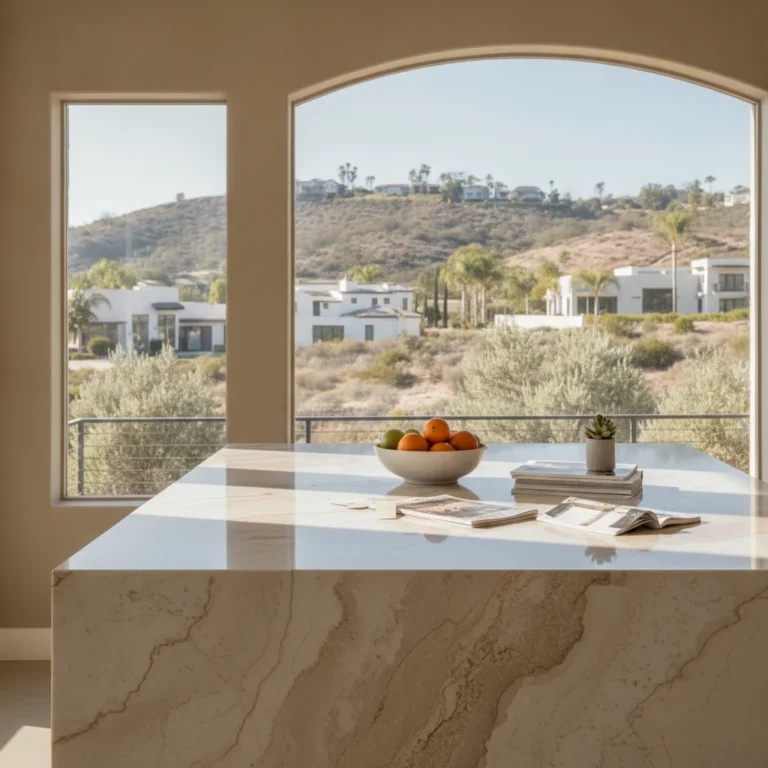
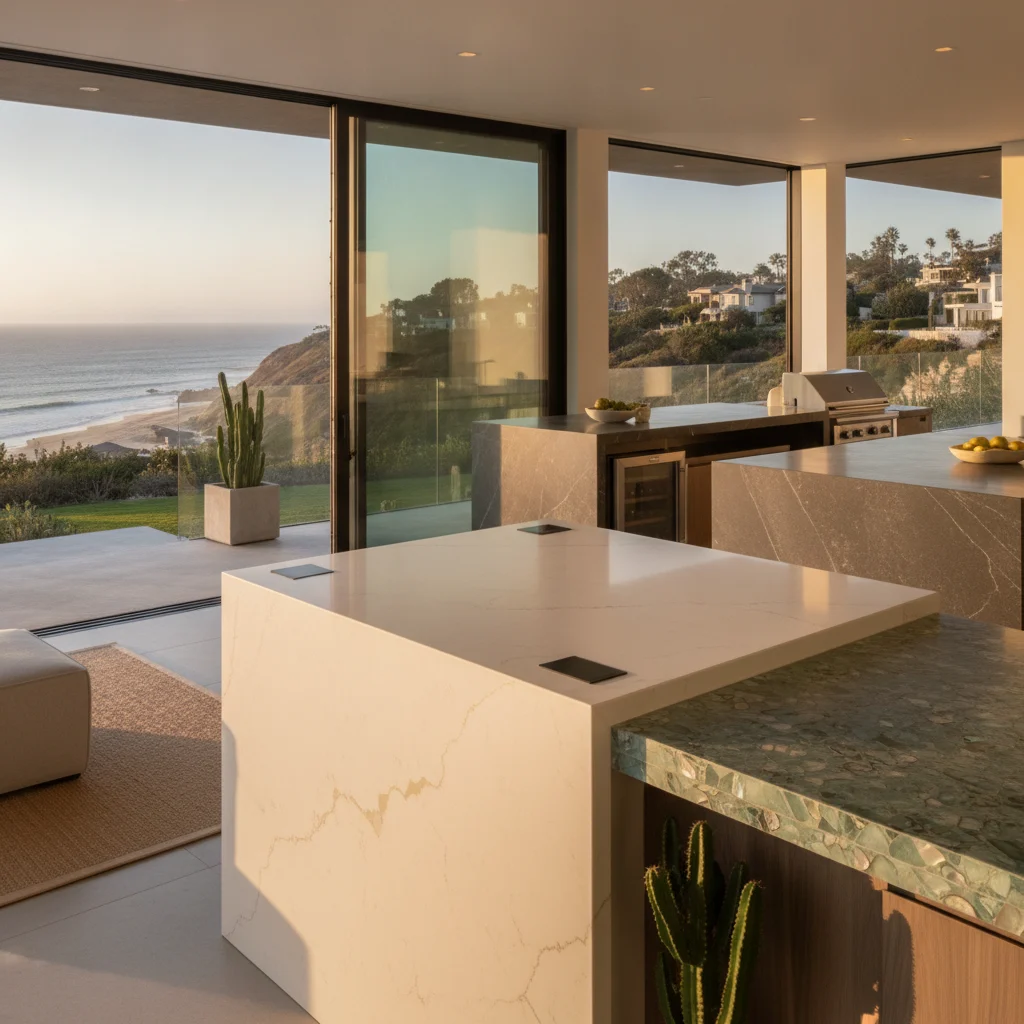
The 2026 design landscape focuses heavily on sophisticated edge fabrication that transforms standard slabs into sculptural centerpieces. Bulky, multi-layered ogee edges have given way to crisp mitered apron drops measuring 2 to 3 inches in height. This technique conceals the stone thickness while creating the optical illusion of a monolithic stone block anchoring the room. Waterfalls spanning the vertical perimeter of central kitchen islands tie horizontal preparation planes directly to wide-plank hardwood floors.
Furthermore, fabricators increasingly incorporate undermount technology and custom solid-slab draining boards with shallow CNC-routed slope channels. These integrated grooves direct runoff directly into the sink basin, preventing pooling around silicone seals. Fluted apron faces and gently curved bullnose radius corners on island ends reduce impact hazards in high-traffic family pathways while introducing soft organic geometry that balances clean, angular modern architecture.
Installation Strategies for Complex Del Mar Architectural Layouts
Del Mar coastal properties often feature architectural irregularities, including radius walls, non-standard structural spans, and broad open-concept sightlines. Flawless execution requires precision laser templating rather than traditional physical timber templates. Advanced 3D digital scanners map perimeter wall variations within fractions of a millimeter, capturing out-of-square framing conditions and plumbing offsets before stone cutting commences.
To guarantee longevity in complex architectural layouts, installers adhere to specific localized guidelines:
- Solid plywood underlayment installation to absorb structural foundation shifting common in coastal hillside soils.
- Heavy-duty steel cantilever support brackets concealed beneath floating breakfast bar overhangs extending past 10 inches.
- Flexible, non-yellowing structural silicone caulking along tile splash intersections to accommodate seasonal coastal thermal expansion.
- Strategic seam placement away from direct sink cutouts and high-stress center spans to preserve structural resilience.
Adhering to these meticulous structural protocols ensures that heavy stone installations remain perfectly level, preventing seam separation and slab deflection over decades of active use.
Environmental Sustainability and Long-Term Surface Maintenance
Modern homeowners increasingly prioritize sustainable sourcing and indoor environmental safety. Leading fabricators now source slabs from quarries operating under certified environmental stewardship programs that recycle up to 95 percent of industrial processing water. Additionally, low-silica engineered surfaces and low-VOC bonding adhesives maintain indoor air quality inside tightly insulated coastal residences, preventing off-gassing and improving residential health.
Long-term maintenance protocols for high-performance stone remain straightforward when executed properly. Natural stone surfaces benefit from periodic penetration with fluoropolymer-based nano-sealers that bond deep inside microscopic mineral pores. Avoid harsh acidic cleaners, ammonia solutions, or abrasive scouring pads. Daily maintenance requires only mild pH-neutral stone soap and soft microfiber cloths to wipe away sea salt residues, airborne grease, and daily kitchen spills. Investing in top-tier Countertops in San Diego guarantees that your surfaces retain their original luster without intensive refinishing schedules.
Partner with Prefab Granite Depot for Premium Countertops
Elevate your Del Mar residence with industry-leading fabrication and turnkey installation from Prefab Granite Depot. Our extensive inventory includes exceptional natural quartzites, premium granites, and advanced engineered porcelain surfaces precision-cut for demanding coastal environments. We guide you through complete material selection, digital laser templating, and rapid flawless installation across Del Mar, Lakeside, Lemon Grove, and Chula Vista. Call our specialist design team directly at 858-330-6782 to schedule your personal showroom consultation and secure a comprehensive project estimate today.
Frequently Asked Questions
Which countertop material performs best in the coastal Del Mar climate?
Metamorphic quartzite and ultra-compact porcelain perform exceptionally well in coastal environments. Both materials resist airborne salt corrosion, withstand direct sunlight without fading, and offer virtually non-porous surfaces that prevent deep moisture staining.
How frequently should I apply sealant to natural quartzite countertops?
You should seal natural quartzite surfaces every one to two years using a high-grade penetrating fluoropolymer sealer. Dense varieties require less frequent application, but regular testing with a small water drop confirms whether the protective barrier remains intact.
Can I install engineered quartz on an outdoor coastal patio?
Standard engineered quartz is unsuitable for outdoor installations because prolonged ultraviolet exposure breaks down its petroleum resins, causing severe discoloration. Ultra-compact porcelain or dense natural granite serve as far superior choices for outdoor Del Mar kitchens.
What countertop edge profile trend is most popular for 2026?
Mitered apron edges measuring 2 to 3 inches remain the leading design trend for modern coastal kitchens. This style delivers a substantial, monolithic appearance that pairs cleanly with waterfall island drops and contemporary minimalist cabinetry.
How long does a full countertop fabrication and installation take?
After final digital laser templating, fabrication typically takes between 7 to 10 business days. On-site installation is usually completed within a single day for standard kitchens, minimizing disruptions to your daily home routine.
How do I prevent countertop seams from separating over time?
Professional installers prevent seam separation by placing structural steel supports beneath overhangs, leveling sub-cabinet bases precisely, and utilizing high-strength epoxy matched to the stone color. High-grade flexible perimeter caulking accommodates seasonal building expansion.